


The Advancement of Open Science at the Université de Lorraine
It is possible to adapt these indicators to the scale of a HAL collection (see an example).
Context
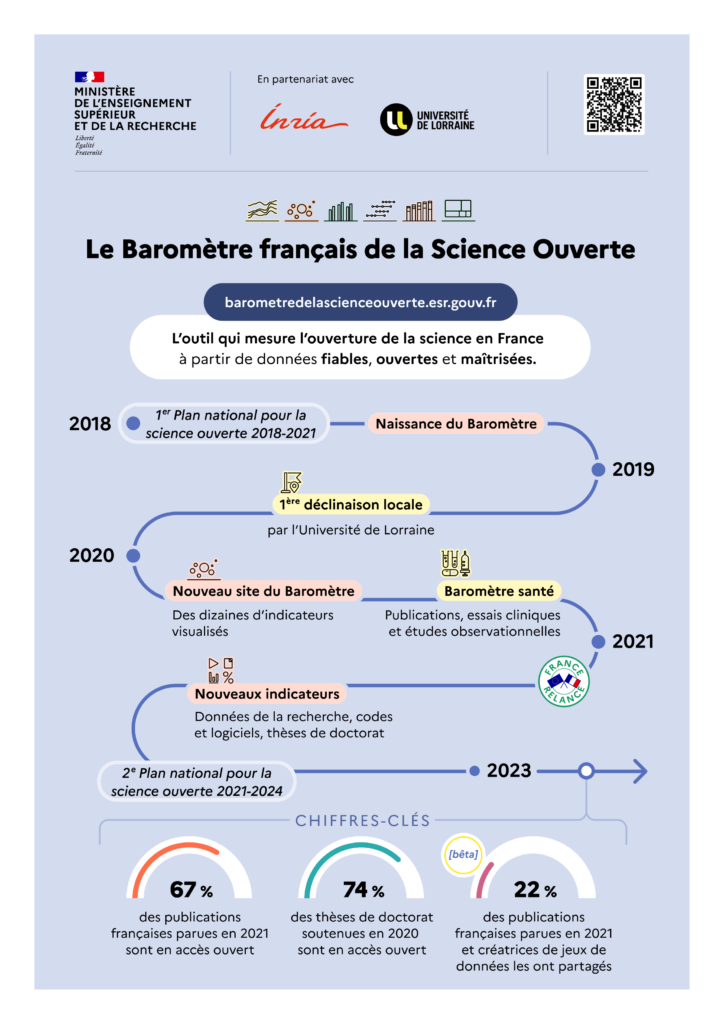
The Université de Lorraine has a steering tool to monitor the progress of Open Science within its scientific production. In 2019, the Ministry of Higher Education, Research and Innovation produced a first version of the French Open Science Barometer. As the data and code of this Barometer are freely reusable, it was possible to take elements of it to write a new code to isolate the publications of the Université de Lorraine. Graphs inspired by the national monitor were thus produced in spring 2020, in order to generate a set of relevant indicators, in numerical and graphical form. This code, developed at the Université de Lorraine, is freely accessible and reusable from this address. Any research institution could thus be inspired to build its own monitor. It is indeed designed to allow a simple and customizable reuse. Please note that only the “Publications” part is treated in this code. The other graphs are based on internal UL sources and cannot be directly reused by other institutions.
The raw data was collected in December 2025. Since that year, the Lorraine Open Science Barometer has relied solely on open sources: OpenAlex and HAL.
The indicators on data and codes are the result of a collaborative project between the Ministry of Higher Education and Research, the Université de Lorraine and Inria.
Since March 2023, publications available in HAL but without a DOI can be processed in the Monitor. In order to keep a coherence with the previous editions of the Monitor, the corpus continues to be the publications with DOI. It is nevertheless possible to look at the overall open access rate when publications without DOI are included. It drops from 65% to 67%. This is due to the important number of records without full text deposited in HAL.
Indicators
General indicators on publications
Indicators by scientific field
Indicators by editor
Indicators by open archive
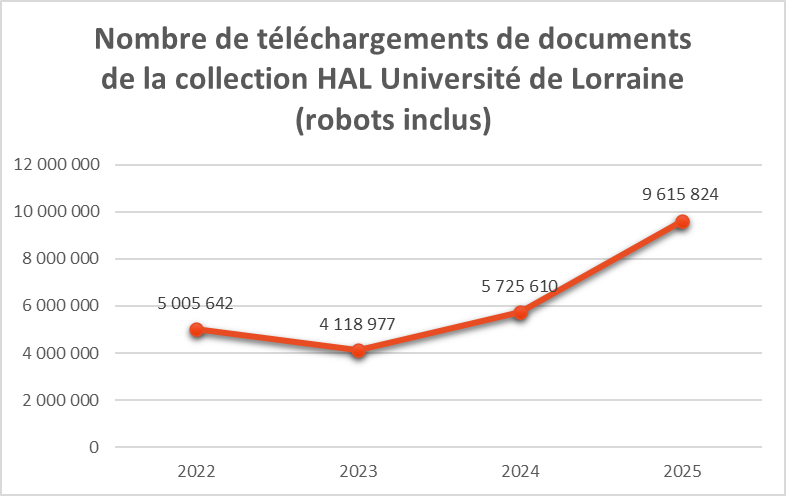
Number of full-texts downloads of the Université de Lorraine HAL collection (robots included)
Indicators on research data linked to publications
Indicators on datasets in repositories
There may be differences between the number of datasets published in Recherche Data Gouv and the number of datasets published in DOREL, the institutional space of the University of Lorraine in Recherche Data Gouv. This is due to the publication of certain Lorraine datasets in other spaces, such as that of the CNRS.
Indicators on code and software linked to publications
Indicators on thesis
APC expenses
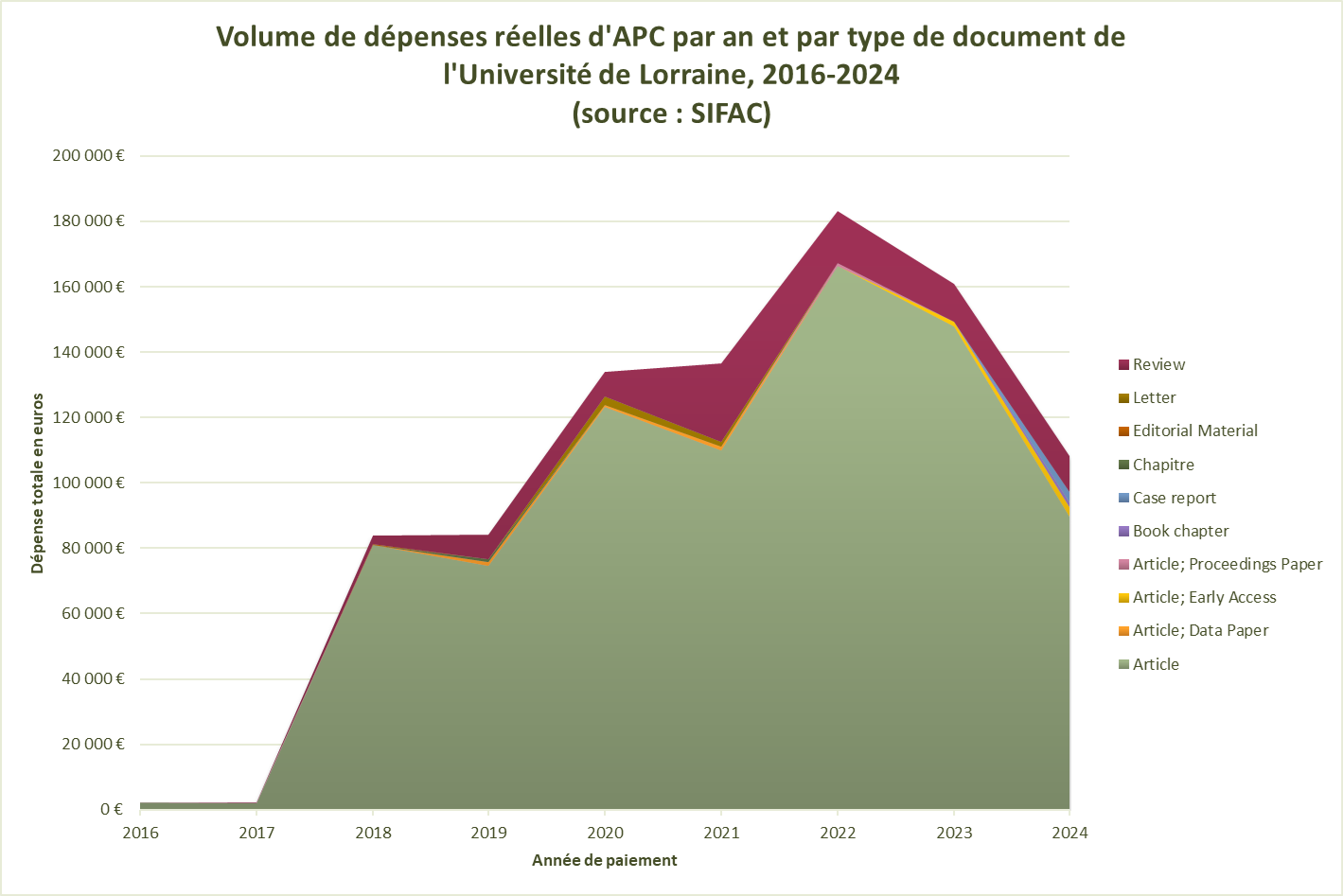
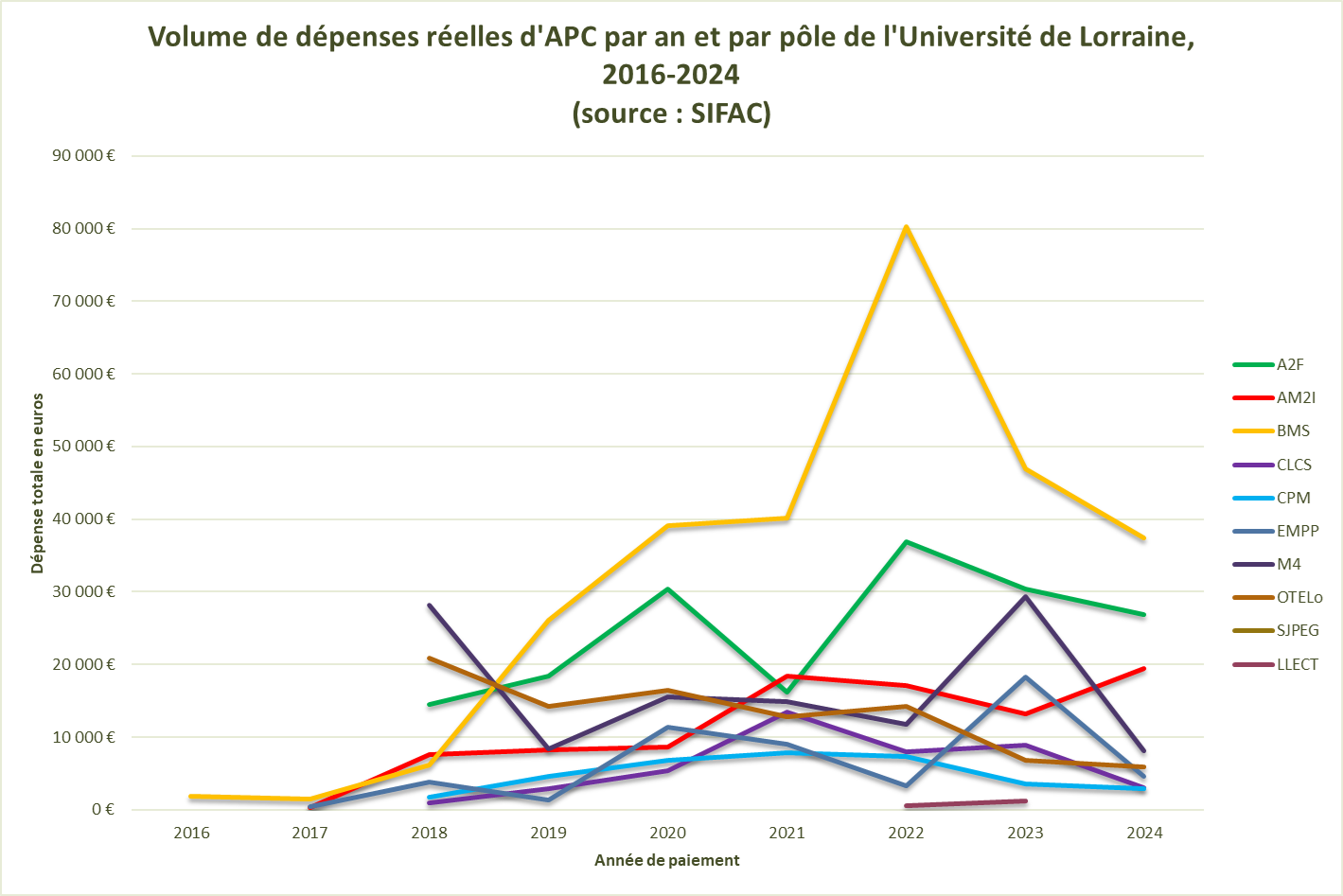
Payment expenses for article processing charges are tracked according to methods detailed in this article (in french). The calculations are made with a one-year time delay to obtain reliable and consolidated results.
Volume of real expenses by year and type of publication (SIFAC accounting software)
Volume of real expenses by year and scientific cluster (SIFAC accounting software)
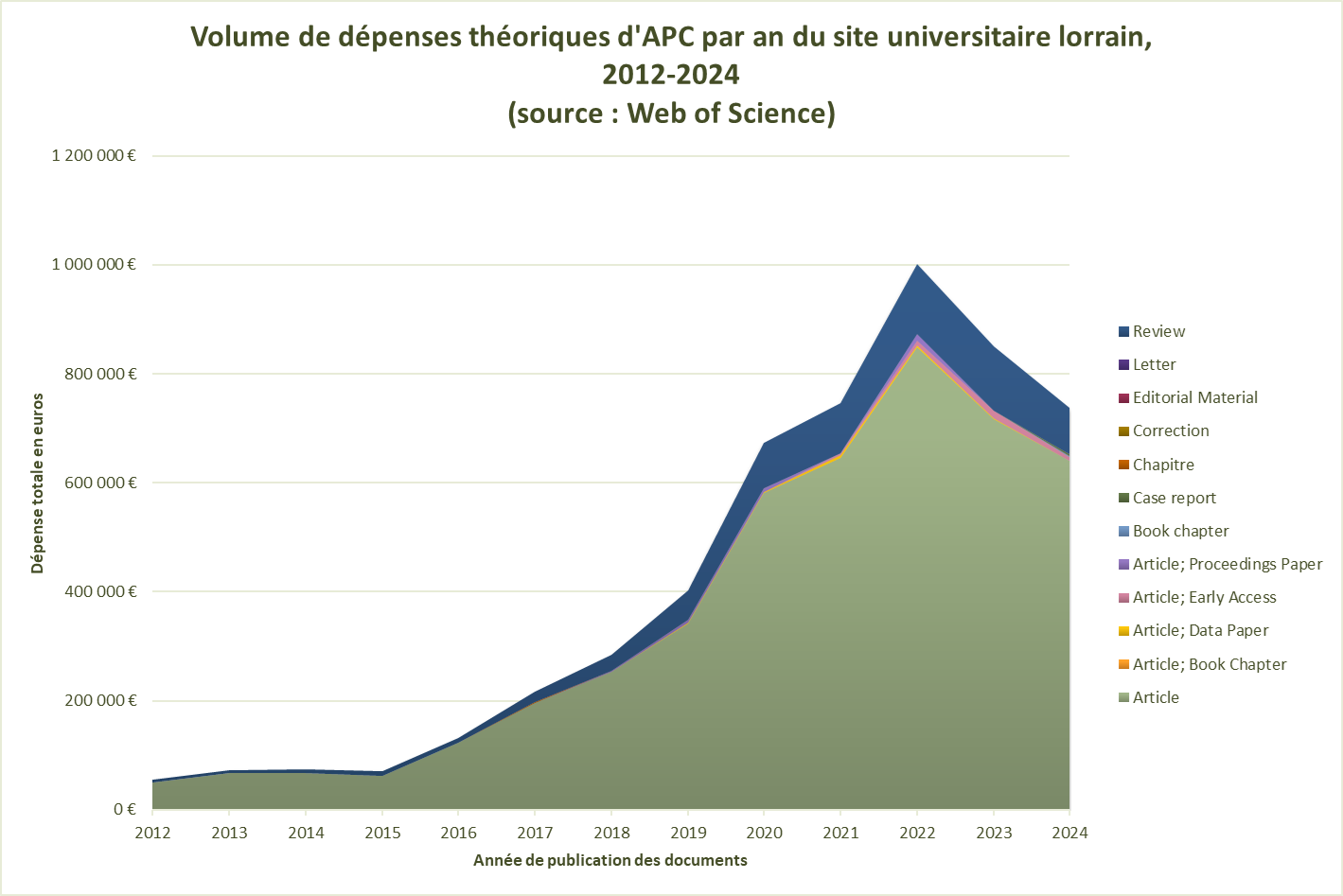
Volume of theoretical expenses by year and type of publication (Web of Science)
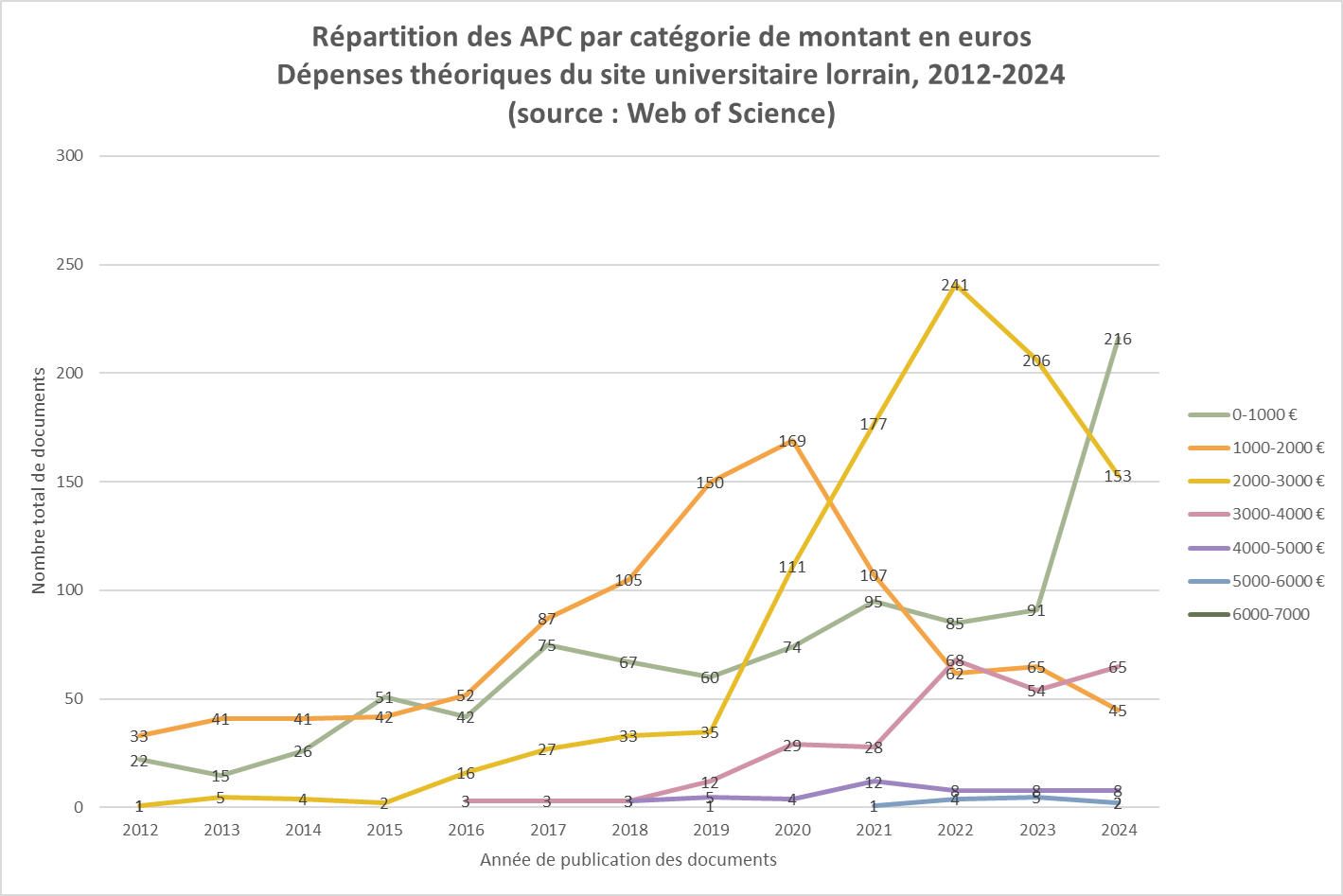
Volume of theoretical expenses by expense amount in euros (Web of Science)
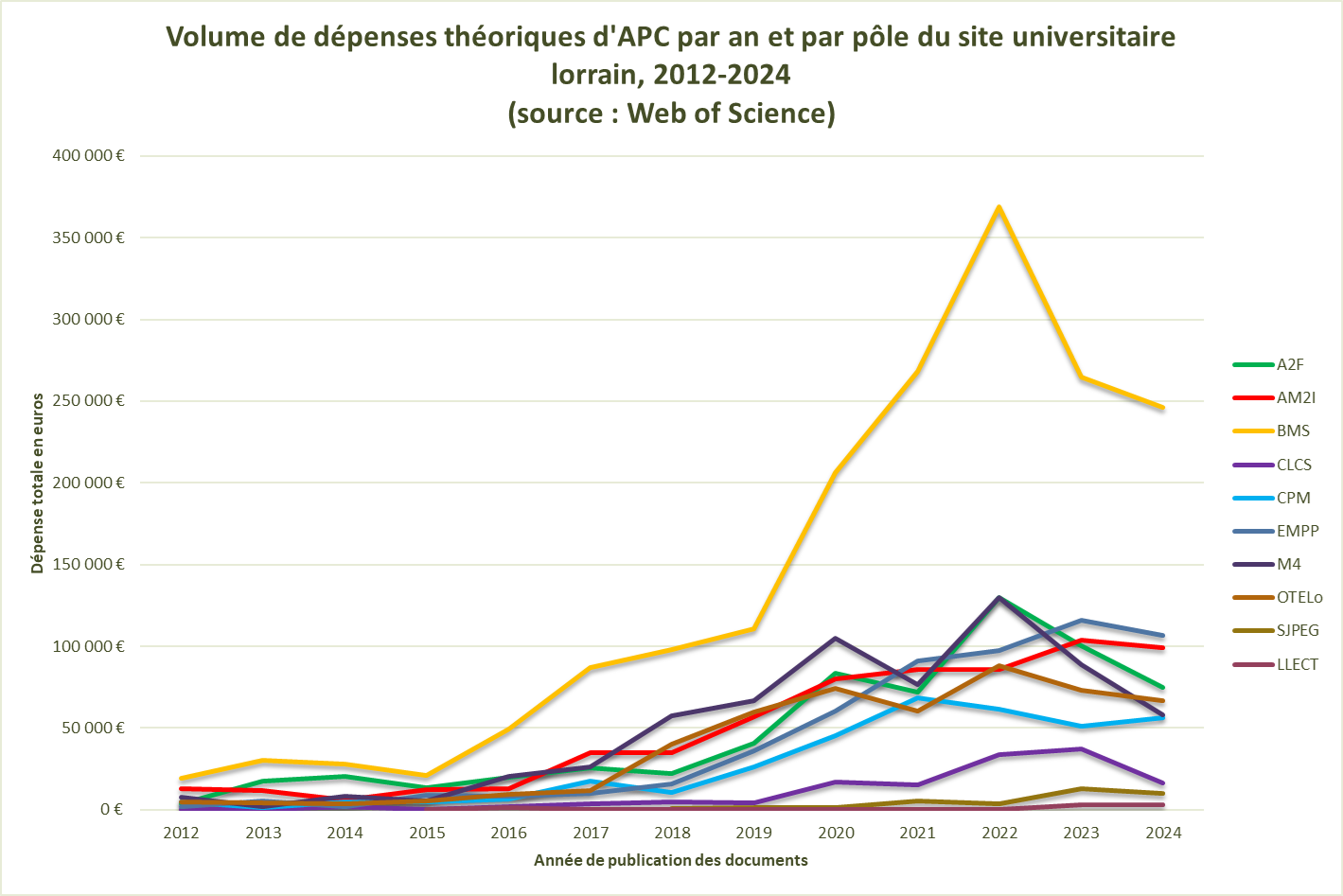
Volume of theoretical expenses by year and scientific cluster (Web of Science)
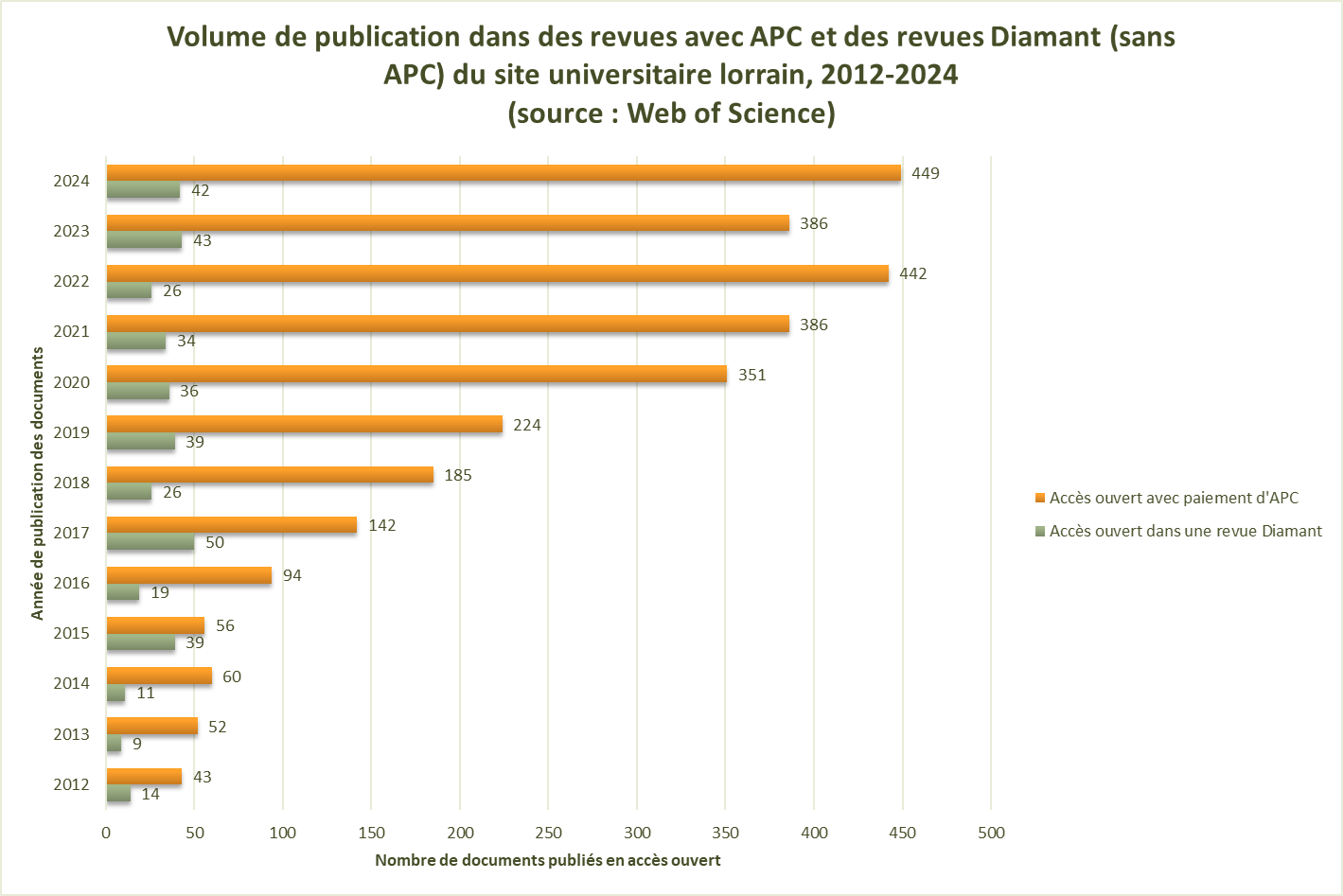
Repartition of articles and reviews with and without APC expenses
Open Science trainings
The Documentation Direction provides Open Science training and support for all staff at the Université de Lorraine.
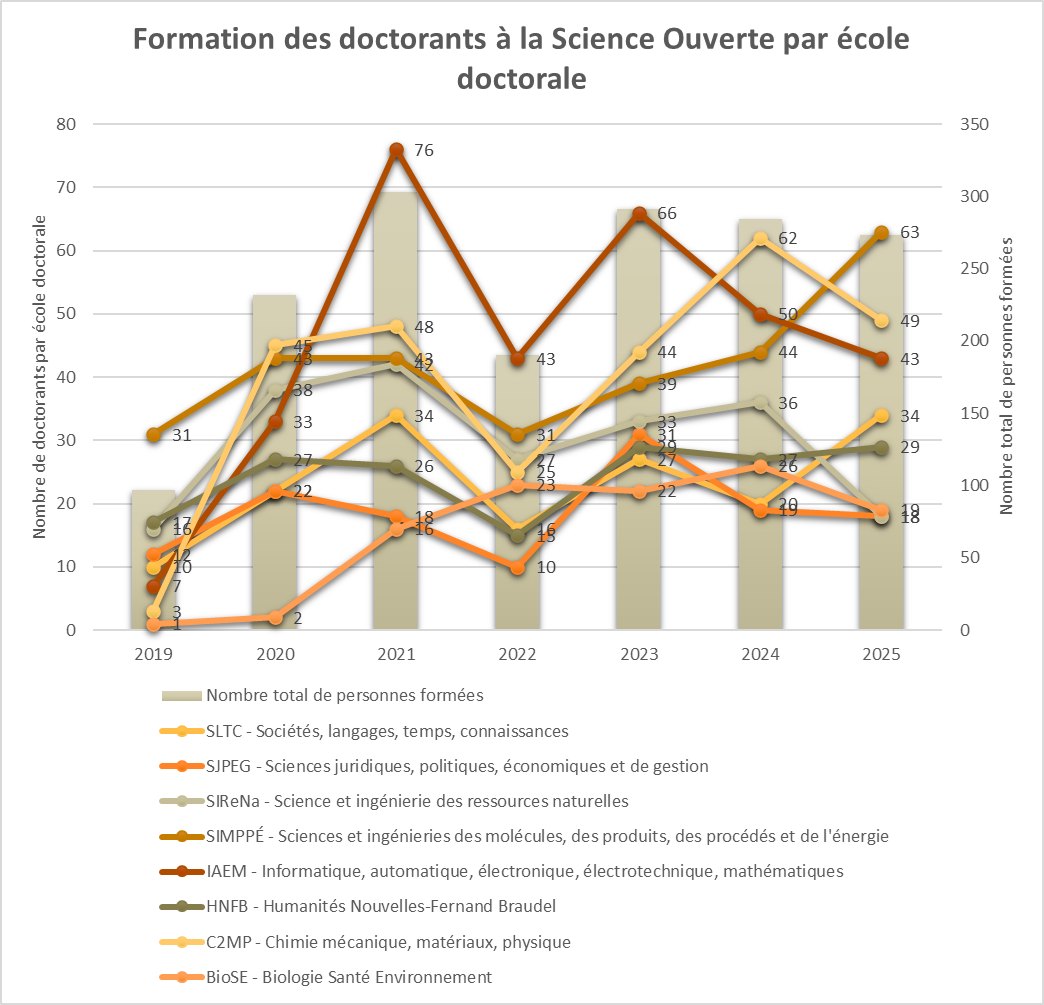
Open Science training for PhD students, by doctoral school
A “trained person” is a single individual who has taken part in at least one training course in one of the “Open Science” modules in the Domptez la Doc catalogue. These courses can last from 1 to 3 hours.
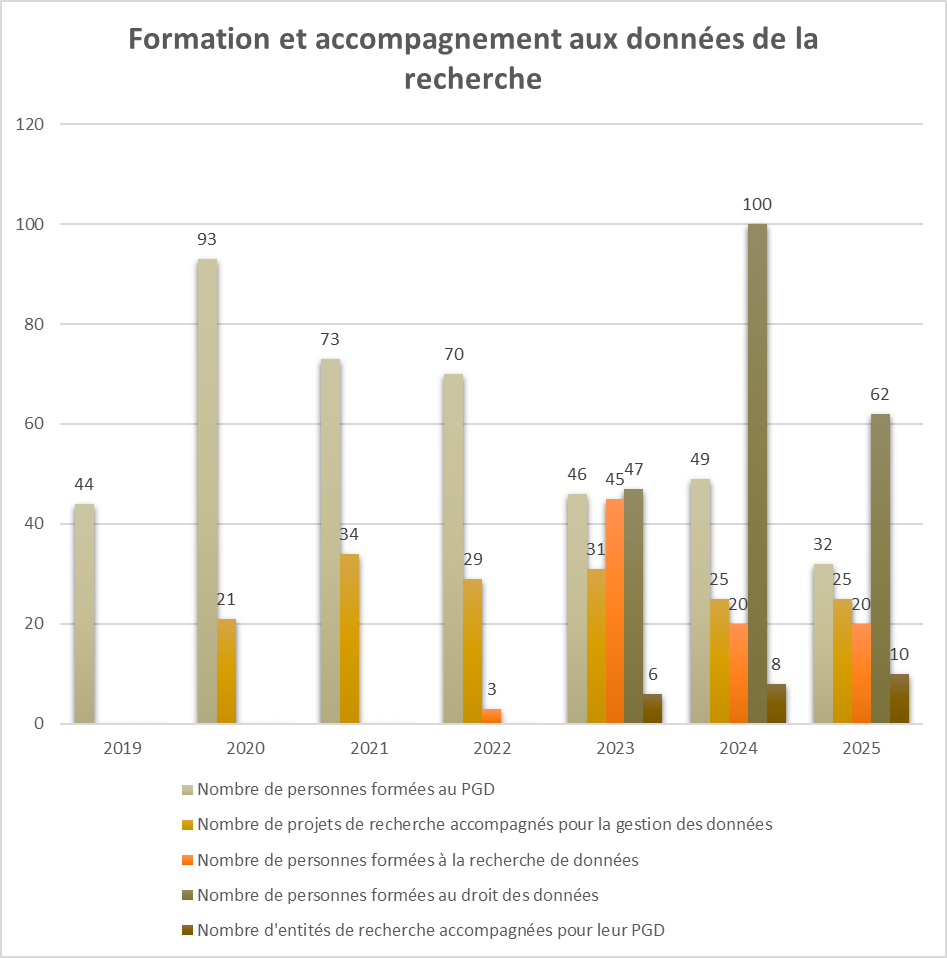
Training and support on research data management
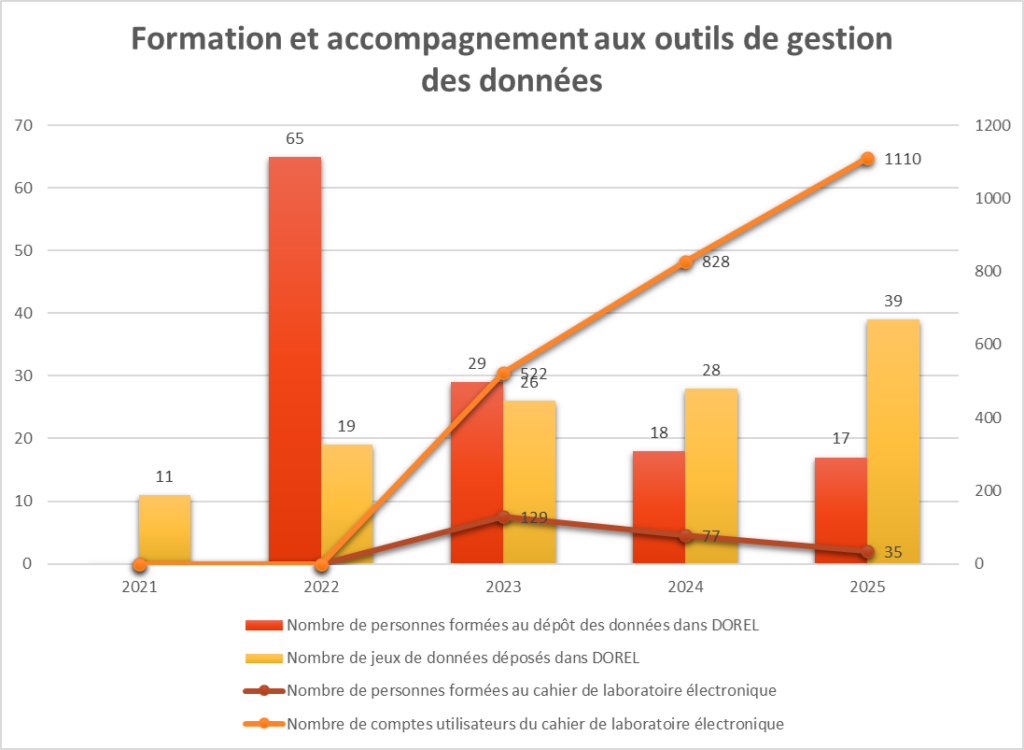
Training and support on data management tools
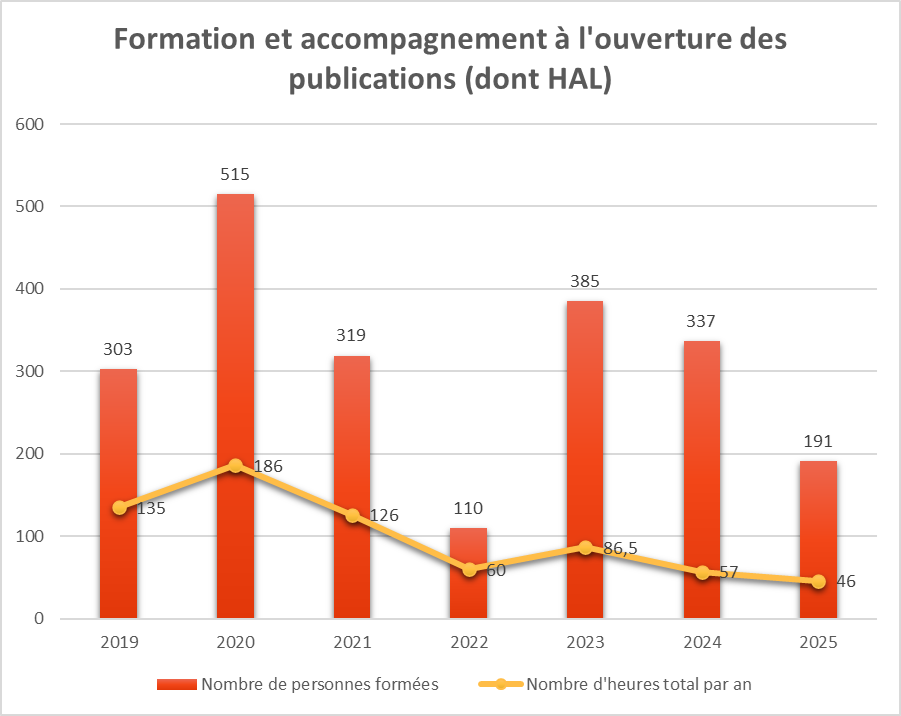
Training and support for opening up publications (including HAL)
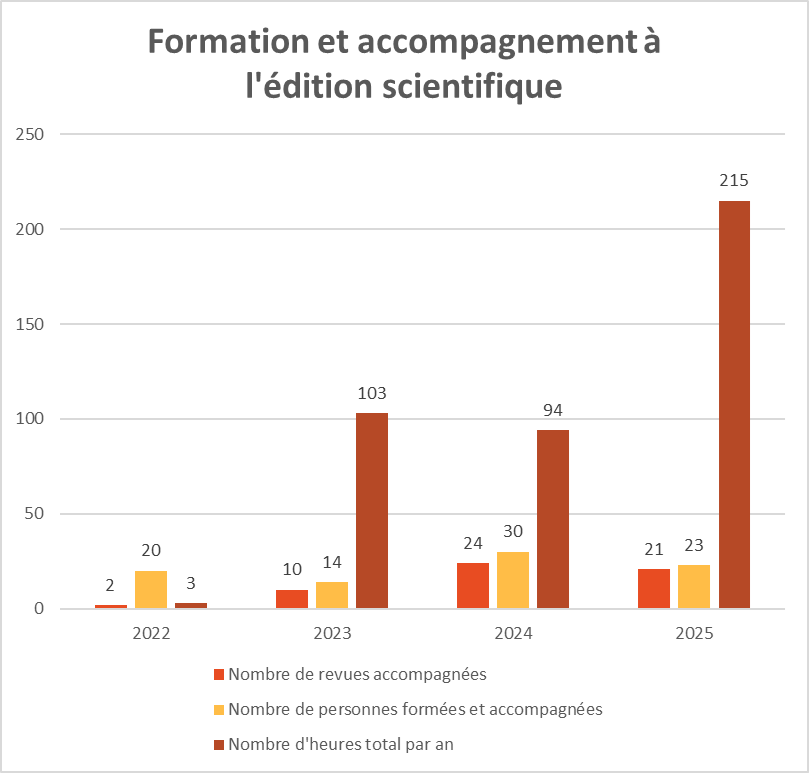
Training and support for scientific publishing
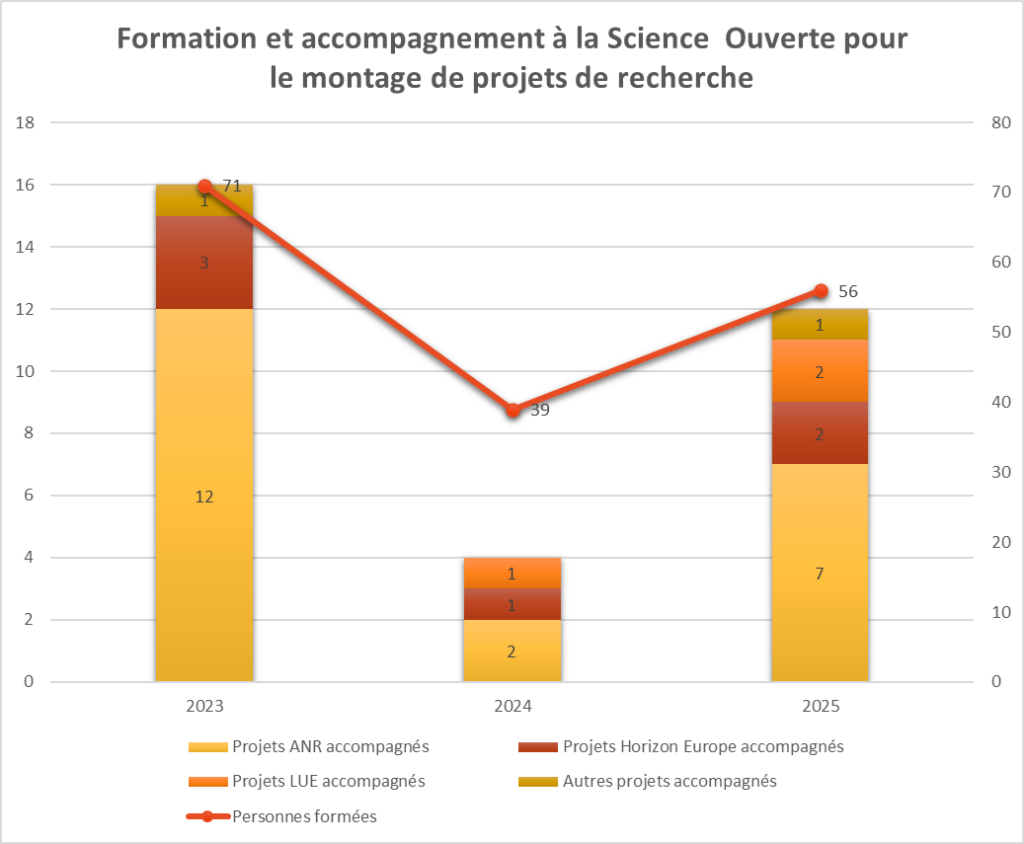
Open Science training and support for setting up research projects
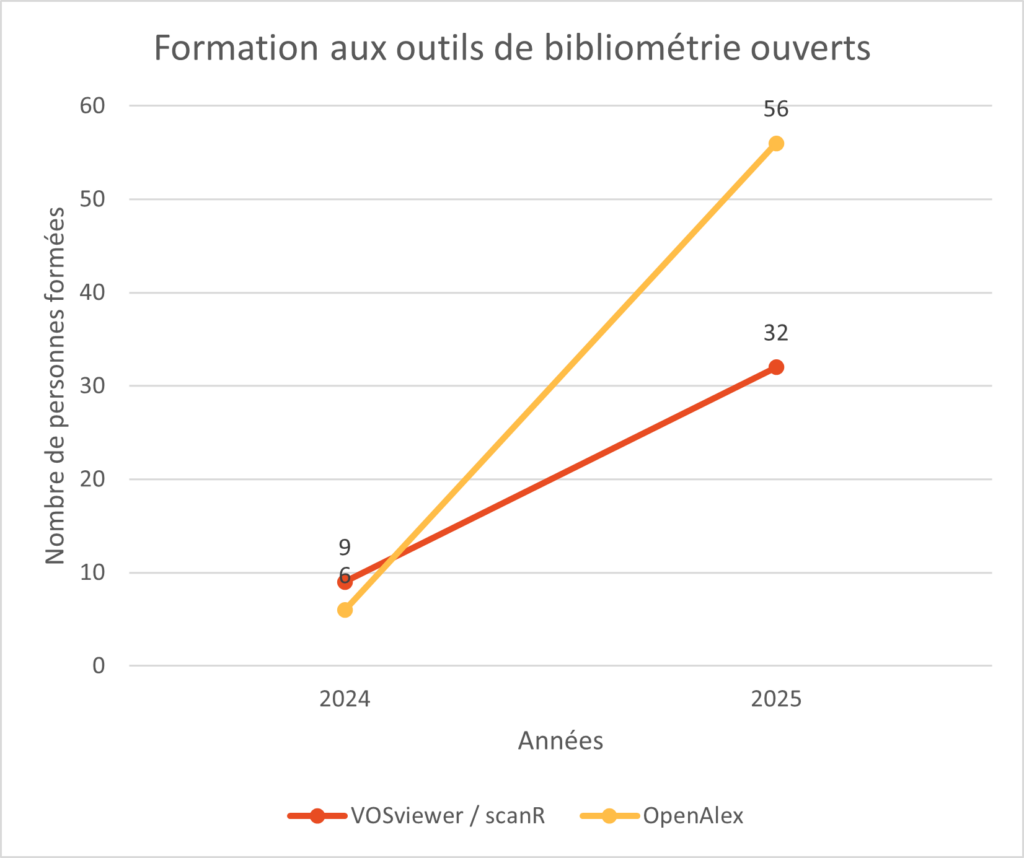
Training and support on open bibliometric tools
Adoption of the ORCID open identifier

Open scientific publishing
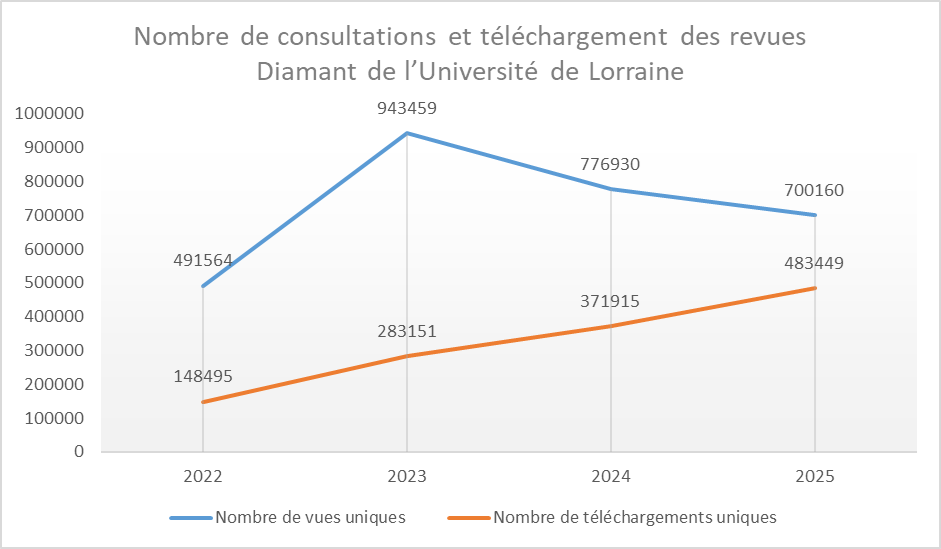
Number of views and downloads of the University of Lorraine’s Diamond journals
This graph summarises the number of views and downloads for 12 Diamond-rated journals affiliated with the University of Lorraine over the period 2022 (the year the journal support service was established) to 2025.
The journals were selected for their close association with the University of Lorraine and the ease of accessing their statistical data. The data has been standardised as far as possible. The journals are in fact published on different platforms (OpenEdition (6), Episciences (3), OpenUBordeaux (1) and laboratory websites (2)), which do not offer the same statistical processing. For some journals, information could not be retrieved for previous years as it is only retained for one year.
It should be noted that view and download figures have skyrocketed due to the very significant increase in visits from web-crawling bots. Consequently, recent journals (established in 2024 and 2025) have very high view and download statistics, far exceeding their human readership alone.
Openness of journals and books published by the Université de Lorraine
