


Our teams offer online workshops throughout the year, lasting from 60 to 120 minutes, covering a large range of Open Science aspects: HAL, data management plan, data law, data repository, electronic laboratory notebook…
Several courses on Open Science can be followed on the Arche platform independently. A training program is also available for doctoral and masters students.



General public training





For PhD students, a certificate of attendance can be issued on request by the trainer. It should be sent to their doctoral school’s pedagogical manager for validation in Adum.
Support staff participation in Open Science workshops is recognised by the Professional Development programme. All training hours completed are reported to the programme by the Libraries once a year, in March, so that they can be taken into account during annual performance reviews.
Open publications
Online workshops
- HAL essential
Objective: Learning the essentials of how to deposit a document in HAL.
Available in French or English.
- HAL essential Humanities
Objective: Learning the essentials of how to deposit a document in HAL. Workshop adapted to the specificities of the Humanities.
- My identity in HAL
Objective: Reviewing your HAL account, your multiple author forms and creating your idHAL and your HAL CV. Understanding the link between IdHAL and ORCID and how to feed your ORCID profile with HAL.
Available in French or English.
- ANR project and HAL
Objective: Knowing how to comply with the HAL filing obligation and monitor publications linked to an ANR-funded project.
The workshop is only for ANR fundings’ recipients.
- Choosing a Creative Commons license
Objective: Understanding how authors’ rights work, learn about the different Creative Commons licenses, and choose the one that best suits your work.
Self-paced trainings
Self-paced training courses are available to doctoral students and staff at the Université de Lorraine via the Arche platform. They can be taken entirely online and are accessible 24 hours a day.
- Introduction to Open Science
Objective: Discovering the panorama of Open Science and its implications for scientific research.
For members of the Université de Lorraine, https://arche.univ-lorraine.fr/course/view.php?id=52614
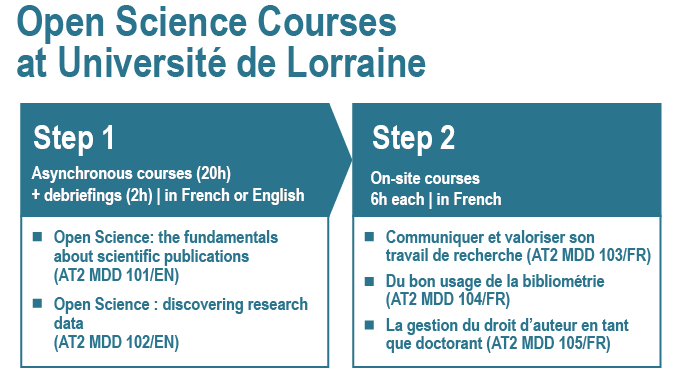
For PhD students, this course, combined with “Submitting your publications on the Open repository HAL”, enables 0.5 credits to be validated in Adum. For more information and to register, visit the page Domptez la Doc ! / Adum, module AT2. MDD 101/EN – Open Science : the fundamentals about scientific publications.
- Submitting your publications on the Open repository HAL
Objective: Discovering open repositories and HAL in particular. Learning how to make a deposit and how to manage its user account.
For members of the Université de Lorraine, https://arche.univ-lorraine.fr/course/view.php?id=30873
For PhD students, this course, combined with “Introduction to Open Science”, enables 0.5 credits to be validated in Adum. For more information and to register, visit the page Domptez la Doc ! / Adum, module AT2. MDD 101/EN – Open Science : the fundamentals about scientific publications.
Research data
Online workshops
- Writing a data management plan
Objective: Discovering what a data management plan is and learning how to use DMP OPIDoR to create one.
For PhD students, this course, combined with “Using an electronic laboratory notebook: eLabFTW solution”, enables 0.5 credits to be validated in Adum. For more information and to register, visit the page Domptez la Doc ! / Adum, module AT2. MDD 102 A – Gérer ses données sans stress tout au long de la thèse.
On request, the workshop can be delivered in English as part of the module Domptez la Doc ! / Adum, module AT2. MDD Gérer ses données sans stress tout au long de la thèse.
- Finding your data
Objective: Discovering how to find data in your field of study.
- Data law
Objective: Discovering the legal framework for research data.
- Personal and sensitive data: applying the legal framework
Objective: Understanding personal data and the RGPD.
- Images and videos: applying the legal framework
Objective: Addressing the legal issues associated with the production and re-use of still and moving images, as part of a thesis, research publication or course.
- Publishing data in a repository (with the example of DOREL/Recherche Data Gouv)
Objective: The publication and controlled opening of research data have become major issues. This workshop will look at the issue of trusted repositories. It will help you to identify and learn about them. Application: the repository itself, with the best practices to be aware of, will be covered on the Recherche Data Gouv repository and the DOREL space in Lorraine, which is hosted there.
For PhD students, this course, combined with “Introduction to the process of publishing a data paper”, enables 0.5 credits to be validated in Adum. For more information and to register, visit the page Domptez la Doc ! / Adum, module AT2. MDD 102 B – Publier et valoriser les données de sa thèse.
- Using an electronic laboratory notebook: eLabFTW solution
Objective: To discover in 1h30 the functions of an electronic laboratory notebook and how it is organised at the Université de Lorraine. A first experiment will be entered using a predefined template to become familiar with the use of the eLabFTW tool.
For PhD students, this course, combined with “Writing a data management plan”, enables 0.5 credits to be validated in Adum. For more information and to register, visit the page Domptez la Doc ! / Adum, module AT2. MDD 102 A – Gérer ses données sans stress tout au long de la thèse.
On request, the workshop can be delivered in English as part of the module Domptez la Doc ! / Adum, module AT2. MDD Gérer ses données sans stress tout au long de la thèse.
- Organizing a large volume of digital files
Objective: How do you make sene of a mass of files? Learn the basic pratices for organizing and processing a large volume of digital files; adopt naming and sorting conventions; share files securely; prepare for archiving. Presentation of the ‘Archifiltre’ diagnostic tool for large volume of files.
- My data after I’m gone: preparing and archiving research data
Objective: Develop practical skills to ensure your research data is ready or archiving and dissemination: archiving in the DMP; metadata for archiving; considering suitable repositories to ensure the integrity and digital preservation of the data.
Self-paced trainings
Self-paced training courses are available to doctoral students and staff at the Université de Lorraine via the Arche platform. They can be taken entirely online and are accessible 24 hours a day.
- Survival Kit for the Research Data World
Objective: Learning how to define research data, how to find it and how to cite it.
For members of the Université de Lorraine, https://arche.univ-lorraine.fr/course/view.php?id=48423
For PhD students, this course, combined with “Producing, managing, storing, disseminating research data”, enables 0.5 credits to be validated in Adum. For more information and to register, visit the page Domptez la Doc ! / Adum, module AT2. MDD 102/EN – Open Science : Discovering research data.
- Producing, managing, storing, disseminating research data
Objective: Understanding the institutional data landscape, being able to write a data management plan and produce quality data.
For members of the Université de Lorraine, https://arche.univ-lorraine.fr/course/view.php?id=48587
For PhD students, this course, combined with “Survival Kit for the Research Data World”, enables 0.5 credits to be validated in Adum. For more information and to register, visit the page Domptez la Doc ! / Adum, module AT2. MDD 102/EN – Open Science : Discovering research data.
- Introduction to the process of publishing a data paper
Objective: Discovering what data articles are, understanding their benefits and mastering the various stages in the publication process.
For members of the Université de Lorraine, https://arche.univ-lorraine.fr/course/view.php?id=66832
For PhD students, this course, combined with “Publishing data in a repository”, enables 0.5 credits to be validated in Adum. For more information and to register, visit the page Domptez la Doc ! / Adum, module AT2. MDD 102 B – Publier et valoriser les données de sa thèse.
AgroParisTech training courses
Doctoral students from the SIReNa school have priority, but all doctoral students, researchers and staff at the Université de Lorraine are welcome to attend the training courses offered by AgroParisTech, subject to availability: information and registration (see offer at the end of the page).
Software
Online workshops
- Referencing my source code in HAL
Objective: How to reference a source code in HAL in connection with its archiving on Software Heritage.
Bibliographic databases – Researchers’ identifiers
Online workshops
- ORCID: manage your researcher identity
Objective: Create, complete and valorise your profile. Obtain UL certified affiliations. Add your publications from HAL and automatise the addition of other publications.
- OpenAlex: publications, datasets, networks workshop
Objective: Discover the OpenAlex platform, the largest database of bibliographic references, to create your bibliography, find data and identify scientific collaboration networks on any type of subject.
- VOSviewer: visualizing bibliometric networks
Objective : In just 1 hour, discover the free VOSviewer software to build maps to visualize scientific networks (authors, institutions, countries, keywords) using bibliographic data from a variety of databases. Discover also the use of scanR for maps and analyses.
Projects set-up
Online workshops
- Setting up your research project (ANR, etc.): incorporating Open Science
Objective: Learn how to anticipate issues related to Open Science and the expectations of the ANR and other funding agencies.
PhD training – ADUM
‘Domptez la Doc!’: a crediting training program
We offer about thirty training courses each academic year from November to June, in French or in English. The program includes training for an efficient documentary research, an optimized management of your bibliography, a better knowledge of the scientific publication circuit, etc.
The equivalent modules in French and English cannot be combined. In case of double registration to a module in French and its equivalent in English, only one validation of 0.5 credit will be registered in Adum.
Open Science PhD training pathway
Other trainings available for PhD students
The general public training offer is available to PhD students from Université de Lorraine : a certificate of attendance can be issued on request by the trainer. It should be sent to their doctoral school’s pedagogical manager for validation in Adum.
Worshops for Master’s students
The Bibliothèques Universitaires de Lorraine Training Department is offering two activities for Masters’ students. The Open Science awareness activity introduces the issues involved in open access to scientific publications and data. The second takes them through the process of publishing a scientific article.
The activities take a cross-disciplinary approach, adapting to all university courses by integrating the specificities of the fields of health, science and technology, as well as the humanities and social sciences while considering their needs and concerns as young researchers.
If you are a Masters supervisor and would like to find out more, please contact the BU Training Department:
Need a tailor-made training course?
You can request tailor-made training courses at the level of your academic department, laboratory, or project.
- For publications, contact the Open Publications Steering Committee:
- For research data management, contact the ADOC Lorraine data support service:
- For codes and software, contact the Software and Codes Operational Committee:
- For bibliometrics, contact the Bibliometrics Team:
- For project set-up, contact:
- For questions regarding digital identity, contact: